Your feet are the foundation of everything above them. When that foundation is off, the effects can travel up through the knees, hips, and lower back in ways most people never connect to their feet. At Freehold Chiropractic in Freehold, custom orthotics are one of the most useful tools we have for patients dealing with a range of pain conditions, and the results often surprise people who came in for a problem they never thought had anything to do with their feet.
What Are Custom Orthotics and How Are They Different?
Custom orthotics are insoles designed and made specifically for your feet. They differ from the generic insoles you find at a pharmacy or sporting goods store in one fundamental way: they’re built around your exact anatomy, not a generic foot shape.
At our practice, we use Foot Levelers custom orthotics, designed using 3D scanning technology. The scan captures the contours of your feet, your arch height and structure, and how you distribute your weight, and that data is used to build an orthotic matched to your specific needs.
A generic insole provides basic cushioning and some general arch support. A custom orthotic is designed around the specific pattern in your feet and aims to change how forces travel through your legs with every step.
What Problems Do Custom Orthotics Help?
This is where patients are often surprised. Most people assume orthotics are just for foot pain, but because the feet are the base of the body’s movement chain, better foot mechanics can help with pain at several levels.
Foot and Heel Pain
Plantar fasciitis, heel spurs, metatarsalgia, and general arch pain are the most direct uses. Orthotics redistribute pressure across the foot, provide targeted arch support, and reduce the repeated overstretching that irritates the tissue. For patients with plantar fasciitis, orthotics are often an important part of long-term management.
Knee Pain
Overpronation, the inward rolling of the foot with each step, makes the knee rotate inward too. Over thousands of daily steps, that rotational stress adds up. Better foot mechanics can reduce that rotational force, which may help knee pain, particularly with conditions like patellofemoral pain.
Hip Pain
The same chain reaction continues upward. Abnormal foot mechanics change how the knee moves, which in turn affects how load reaches the hip. Leg length differences, whether structural or functional, also affect how you load each hip and can be partly addressed with orthotics. Many patients with hip pain find orthotics contribute to their overall improvement.
Lower Back Pain
This connection surprises patients most. When the feet roll in or out too much, the pelvis can tilt and rotate to compensate, creating uneven loading of the lower back over time. Research on orthotics for back pain is still growing, but studies suggest they may help people whose foot mechanics are part of the problem. I cover this in my posts on why your feet might be causing your back pain and how flat feet can lead to back and neck pain.
Many patients who come in mainly for back pain end up with orthotics as part of their care plan because the 3D foot scan reveals a pattern contributing to their spinal problems.
Shin Splints and Lower Leg Pain
Shin splints are often linked to overpronation that adds rotational stress to the shin with each stride. Better foot support, combined with addressing ankle and foot restrictions, may help recurrent shin splints that running shoes alone haven’t fixed. Sharp pain in one spot on the shin can signal a stress fracture and should be checked by a doctor.
The Foot Levelers Fitting Process at Our Practice
Getting fitted for custom orthotics at Freehold Chiropractic is straightforward and takes only a few minutes of scanning time. Here’s how it works.
Step 1: Comprehensive Evaluation
Before we scan anything, I do a clinical assessment of your feet, ankles, and legs. I look at your arch structure, how your feet load when you stand and walk, ankle mobility, and any areas of tenderness or restriction, which gives context to what the scan shows.
Step 2: 3D Digital Foot Scan
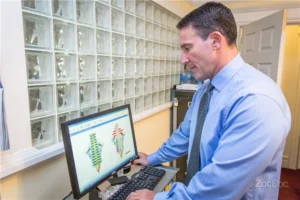
You stand on a scanning plate that captures a 3D image of both feet, measuring arch height, foot length and width, and pressure distribution across all three arches of the foot. It takes about two minutes and is completely painless.
Step 3: Custom Orthotic Design
The scan data goes to the Foot Levelers laboratory, where your orthotics are made to the specifications of your feet and your clinical needs. Unlike many off-the-shelf insoles that only address the main arch, Foot Levelers orthotics are designed to support all three arches of the foot.
Step 4: Fitting and Follow-Up
When your orthotics arrive, I’ll check the fit and make sure they’re working as intended. I’ll also guide you on how to break them in, since a gradual start helps your body adapt comfortably.
Custom Orthotics vs. Store-Bought Insoles: Is the Difference Worth It?
I get this question a lot. Store-bought insoles aren’t useless, and for some people they’re enough. But they’re designed for an average foot, so they provide average support. If your foot mechanics fall outside that average, a generic insole may cushion your foot without changing the underlying pattern.
Custom orthotics, built from a scan of your own feet, are designed to address your specific pattern. For many patients with chronic pain linked to foot mechanics, that tailored support makes a real difference.
That said, custom orthotics work best as part of a comprehensive approach that also addresses the joint restrictions, muscle imbalances, and spinal issues contributing to the problem. Orthotics support the foundation, and chiropractic care addresses everything built on top of it. I explain how the two work together in my post on foot orthotics and chiropractic for low back pain.
Who Is a Good Candidate for Custom Orthotics?
Custom orthotics can benefit a wide range of patients, but some situations make particularly strong candidates:
- Plantar fasciitis that hasn’t resolved with stretching and rest
- Flat feet or high arches causing pain anywhere from the foot to the lower back
- Knee pain that worsens with walking, running, or stairs
- Athletes with recurring lower body injuries
- People who stand or walk on hard surfaces for long periods at work
- Lower back pain that worsens with long periods of standing or walking
- Anyone whose 3D foot scan shows a significant imbalance
When to See a Doctor First
See a doctor promptly for sudden foot pain after an injury, a foot that’s red, hot, and swollen, or numbness and burning in your feet. If you have diabetes, have your doctor check any new foot pain, numbness, or sores before starting orthotics.
Frequently Asked Questions
How long do custom orthotics last?
With normal use, Foot Levelers custom orthotics typically last one to three years. Very active patients, or those who wear them daily in work boots or athletic shoes, may need replacements sooner, and we’ll let you know when a re-evaluation makes sense.
Can I use my orthotics in different shoes?
Yes, in shoes with removable insoles. Many patients move them between everyday and athletic shoes, while some choose a second pair for very different footwear like dress shoes.
How long does it take to get used to custom orthotics?
Most people adjust within one to two weeks. Start by wearing them a few hours a day and gradually increase.
Start With a Solid Foundation
If you’re dealing with foot, knee, hip, or lower back pain and haven’t had your foot mechanics evaluated, it’s worth finding out whether your foundation is part of the problem. Call Freehold Chiropractic at (732) 780-0044 or schedule your visit online. Our $49 new patient exam includes a 3D orthotics foot scan as part of the comprehensive evaluation.
Dr. Russell Brokstein is a lifelong Freehold resident and a seasoned chiropractor dedicated to helping patients achieve optimal health through holistic, drug-free care. With a Biology degree from Penn State and a Doctor of Chiropractic from Life Chiropractic College West, Dr. Brokstein’s passion for chiropractic began when his own recurring bronchial issues and a sports-related back injury were resolved through chiropractic adjustments. This transformative experience inspired him to focus on full-body treatments, therapeutic stretching, nutritional counseling, and stress reduction therapies to help others recover faster and perform better. Recognized as one of America’s Best Chiropractors, he leads Freehold Chiropractic with a patient-centered approach that emphasizes thorough evaluations, minimal wait times, and personalized care for athletes and families in Freehold, NJ.