
IT band syndrome is one of the most common overuse injuries I see in runners, cyclists, and active patients at our Freehold practice. It produces a sharp, burning pain on the outside of the knee that often shows up at a predictable point in your run or ride, and it has a frustrating habit of returning whenever you ramp activity back up. The good news is that with the right approach, this is one of the most fixable conditions in sports medicine, once you address the actual cause and not just the symptom.
What Is the IT Band?
The iliotibial band, or IT band, is a thick band of connective tissue that runs along the outside of the thigh from the hip to just below the knee. It’s not a muscle. It’s a strong, fibrous band that stabilizes the leg during activity.
IT band syndrome occurs when this band becomes irritated, usually as it passes over the lateral femoral epicondyle (the bony bump on the outside of the knee). The repetitive friction and compression at this point creates inflammation and pain.
The pain pattern is classic: sharp or burning pain on the outside of the knee that worsens with activity, particularly running downhill or going down stairs, and often improves with rest only to return when activity resumes.
What Actually Causes IT Band Syndrome
For years, the standard advice for IT band pain has been to stretch and foam roll the IT band itself. That advice misses the point. The IT band isn’t really the problem. The problem is what’s causing the band to be overloaded in the first place.
Weak Hip Stabilizers
This is the most common underlying contributor by far. When the gluteus medius and other hip stabilizers are weak, the pelvis drops on the opposite side with each step, and the IT band has to work harder to control hip motion. Strengthen these muscles and most cases of IT band syndrome resolve.
Foot Mechanics
Overpronation, where the foot rolls inward excessively during each stride, causes the lower leg to rotate inward as well. This adds rotational stress at the knee and tension on the IT band with every step. Custom orthotics are often a key part of treatment when foot mechanics are contributing.
Training Errors
Sudden increases in mileage, too much downhill running, worn-out shoes, and inadequate recovery all contribute. The 10% rule (don’t increase weekly mileage more than 10%) exists for a reason.
Biomechanical Imbalances
Leg length differences, pelvic misalignments, and lumbar spine dysfunction all change how forces transmit through the lower extremity. Small imbalances become significant over thousands of repetitions.
Tight Hip Flexors
When the hip flexors are tight, they pull the pelvis into a forward tilt and inhibit gluteal function, which then contributes to the hip stabilizer weakness that drives IT band issues. The cycle reinforces itself.
Why Foam Rolling Alone Doesn’t Fix It
Most runners with IT band pain have spent hours foam rolling the outside of their thigh. Some get short-term relief from the muscle work, but the pain comes right back as soon as they start running again. There’s a reason.
The IT band itself is not actually getting “tight” the way a muscle does. It’s a tough fibrous band that doesn’t lengthen meaningfully from rolling or stretching. What you’re really doing when you foam roll is providing some temporary soft tissue input that masks the underlying mechanical problem.
Real, lasting resolution requires fixing the hip mechanics, the foot mechanics, and the strength deficits that are loading the band in the first place. That’s the part most runners never get to.
How We Treat IT Band Syndrome at Our Freehold Practice
Effective treatment for IT band syndrome requires addressing the whole kinetic chain, not just the knee. Here’s the approach:
Comprehensive Lower Extremity Evaluation
I start by assessing foot mechanics, ankle mobility, knee alignment, hip strength and mobility, and lumbar spine function. The IT band irritation is the symptom. The cause is somewhere in this chain, and finding it is the first step.
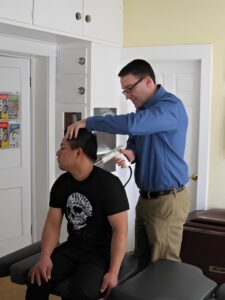
Joint Adjustments
Restrictions in the lumbar spine, pelvis, hip, knee, or ankle can all contribute to abnormal loading of the IT band. Our extremity care addresses these joints throughout the lower kinetic chain.
Targeted Strengthening
The gluteal medius and other hip stabilizers need to be specifically targeted. Generic squats and lunges don’t reliably activate these muscles. I’ll give you specific exercises designed to wake up and strengthen the hip stabilizers that aren’t doing their job.
Foot Biomechanics Assessment
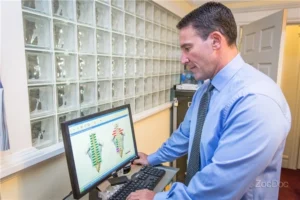
For patients with significant pronation or other foot mechanics issues, our 3D foot scan gives objective data about what’s happening at the foundation. Custom orthotics may be part of the long-term plan for runners and cyclists who need to address foot mechanics for lasting relief.
Soft Tissue Work
While the IT band itself doesn’t lengthen meaningfully, the surrounding muscles and the fascia connections do respond to targeted soft tissue therapy. Releasing the tensor fascia latae, hip flexors, and lateral quadriceps reduces tension on the system and supports the strengthening work.
Activity Modification and Training Guidance
I’ll help you scale activity appropriately during recovery and give guidance on training adjustments to prevent recurrence once you return to full activity. Our sports and performance care approach is designed for athletes who want to keep training, not be sidelined.
How Long Does Recovery Take?
Most patients see meaningful improvement within 4-8 weeks of starting comprehensive care, though full return to previous training volume may take longer depending on severity and how long the condition has been present. Patients who address the underlying mechanical issues thoroughly tend to stay better. Those who only manage the symptoms tend to deal with recurring flare-ups.
What You Can Do Right Now
- Cut volume, not consistency: Reduce your weekly mileage or training load significantly while you address the issue, but try to maintain some movement.
- Strengthen the gluteus medius: Side-lying leg raises, clamshells, and single-leg work all target the hip stabilizers.
- Check your shoes: Running shoes with more than 400-500 miles on them often contribute to overuse injuries.
- Avoid running on a cambered road surface: Always running in the same direction on a sloped road creates uneven loading that aggravates IT band syndrome.
- Get evaluated: Self-treating IT band syndrome rarely solves the underlying cause.
Frequently Asked Questions
Can I keep running while I rehab IT band syndrome?
In many cases yes, with modifications. We typically reduce volume, avoid hills temporarily, and focus on the strengthening work alongside continued lower-impact activity. Total rest isn’t usually necessary or helpful.
Is IT band syndrome the same as runner’s knee?
No. Both involve knee pain in runners, but they’re different conditions. Runner’s knee, or patellofemoral pain syndrome, involves pain around or behind the kneecap. IT band syndrome involves pain on the outside of the knee. The causes and treatment approaches overlap somewhat but aren’t identical.
Stop Cycling Through the Same Flare-Ups
If IT band pain has been limiting your training, the answer is rarely more stretching or foam rolling. It’s addressing the underlying mechanics. Call Freehold Chiropractic at (732) 780-0044 or schedule your evaluation online. Our $49 new patient exam includes a comprehensive orthopedic and chiropractic evaluation and 3D foot scan.